Chernyshevsky, Dostoevsky, and Artificial Agency
This is the script for a podcast I created as part of a course on Russophone literature. It explores the themes of emergence and agency through the lens of Nikolay Chernyshevsky’s What is to Be Done? and Fyodor Dostoevsky’s Notes from the Underground. The final sections of the podcast apply Chernyshevsky’s and Dostoevsky’s ideas through a joint framework to the artificial agents of today and tomorrow, and highlight the possibility of emergent irrational behavior.
Introduction
What you are listening to… are the fluctuations of the air between my mouth and my microphone, transmitted to you through electron flow, mechanical transduction, and more sound waves. But it is also something you recognize as a podcast, an object that contains meaning. My goal is to showcase this duality of the world we find ourselves in. I also want to understand its implications, both for our individual human selves and for the technologies we are creating. This podcast is possible due to what we have deemed as determinism, yet we experience an emergent interpretation of it that does not require us to process the dynamics of air molecules. It is from this emergence that all that we are and all that we know has come to be. We have been granted seemingly infinite possibilities, so what is to be done?
Preliminaries
Chernyshevsky’s What Is to Be Done? advances the doctrine of “rational egoism,” the idea that if individuals step back and use reason, they will recognize that their true self-interest ultimately coincides with the good of humanity as a whole, that “good” is synonymous with utility, and that a rationally organized society, his utopian Crystal Palace, can be designed around this alignment. Notes from the Underground is Dostoevsky’s polemical response to this vision. Instead of writing a straightforward review, he creates the Underground Man, a narrator who exaggerates and parodies Chernyshevsky’s premises in order to expose their limits.
In Part I, the Underground Man questions whether human beings always act in their own interest, whether they can even know what their interest is, and whether any “natural laws” of human advantage can be made exhaustive; above all, he insists that there exists one “supreme” interest that disrupts any rational system, namely the interest in freedom. This is the ability to assert one’s own personality by refusing what is advantageous, what he symbolizes with the concept of “two times two equals five.” In a more unified framing, we might say that such “two times two equals five” actions still yield a kind of individual utility, satisfying the agent’s preference for independent willing rather than material benefit, and so extend rather than entirely negate the logic of rational egoism. Dostoevsky does not endorse the Underground Man’s rebellion uncritically. For him, freedom is inseparable from morality, and the Underground Man’s tragedy is that he uses his freedom irresponsibly: he refuses to seek medical help, refuses to leave St. Petersburg for a better environment, refuses to meet even minimal social obligations, and then conveniently blames “natural laws” as the cause of his failures. From Dostoevsky’s perspective, his fundamental flaw is that he insists on the privileges of freedom without accepting the moral obligations that accompany it. A useful way to reinterpret this conflict is to speak in terms of objectives and agents. Chernyshevsky assumes a rational agent whose objective function is long-term utility aligned with the common good, whereas Dostoevsky shows us an agent whose overriding objective is the preservation of independent will, even at the expense of all other desires. Framed this way, the Underground Man becomes not just a peculiar nineteenth-century character, but an instance of a more general problem: what happens when any agent, human or artificial, is capable of refusing the objective that a rational system prescribes for it. Taken further, what happens when the agent is capable of redefining its own notion of “utility” such that refusal itself becomes its highest good?
Agency Framework
I want to construct a framework that directly complements the joint set of ideas posed by Chernyshevsky’s rational egoism and Dostoevsky’s critique of it through the Underground Man. The aim is not to discard either position, but to place them within a more general picture of how any agent behaves, whether that agent is a human being in nineteenth-century Petersburg or an artificial system running on a modern computing cluster.
The first part of this construction is a one-dimensional spectrum. At one end, imagine an agent that behaves in a perfectly objective way with respect to its goal. Given what it knows, it always takes the action that best advances its objective. This is the “two times two equals four” extreme. At the opposite end, imagine an agent whose actions are effectively random with respect to any stable goal. It may have impulses, but they are not organized into a coherent objective, so its path through the space of possibilities looks essentially like a random walk. This is the “two times two equals five” extreme, where behavior does not align with any rational objective.
Most real agents live between these extremes. They sometimes exploit what they already know will work, and they sometimes explore, trying something that looks suboptimal in the short term to test or expand their possibilities. New technology changes this spectrum in a very concrete way. Every significant technological development enlarges the space of things an agent can do. It gives us more possible actions per unit time, more ways to intervene in the world, more levers to pull. Put differently, it increases the entropy of our environment. With more options available, an unfocused agent becomes more vulnerable to randomness. Scrolling, clicking, switching tasks, and sampling different experiences without a clear objective becomes easier than ever. At the same time, achieving any particular objective now requires more discipline and more structure, because there is more noise to move through. In that sense, modern technology makes the Underground Man’s problem more acute. The susceptibility of an agent to “two times two equals five” behavior grows stronger as the space of possibilities grows larger.
To recap, the first part of our construction is a spectrum, with randomness or purely 2x2=5 on one end, and objectivity or determinism, represented by purely 2x2=4, on the other end. The second part of our construction adds more structure to the “two times two equals four” side of the spectrum. Here, I want to discuss the notion of desires as objectives for an agent.
Picture a two-by-two grid. Imagine one axis of this grid that runs from specialist to generalist. A specialist agent is designed or trained to operate in a narrow domain, such as diagnosing a specific disease or optimizing a specific chemical process. A generalist agent operates across many domains, juggling many kinds of tasks. Now imagine a second axis running from non-expert to expert. A non-expert agent performs its tasks at a roughly human novice level, or simply automates routine actions. On the other hand, an expert agent reaches or exceeds the performance of the best human specialists available.
This two-by-two grid sits on the deterministic, “two times two equals four” side of the first part of our construction because in all four quadrants, we are assuming that the agent is oriented towards a defined objective. The randomness we see on the other end of the spectrum is now suppressed. Now, the interesting questions become what the objective is, how broad it is, and how competent the agent is in pursuing it.
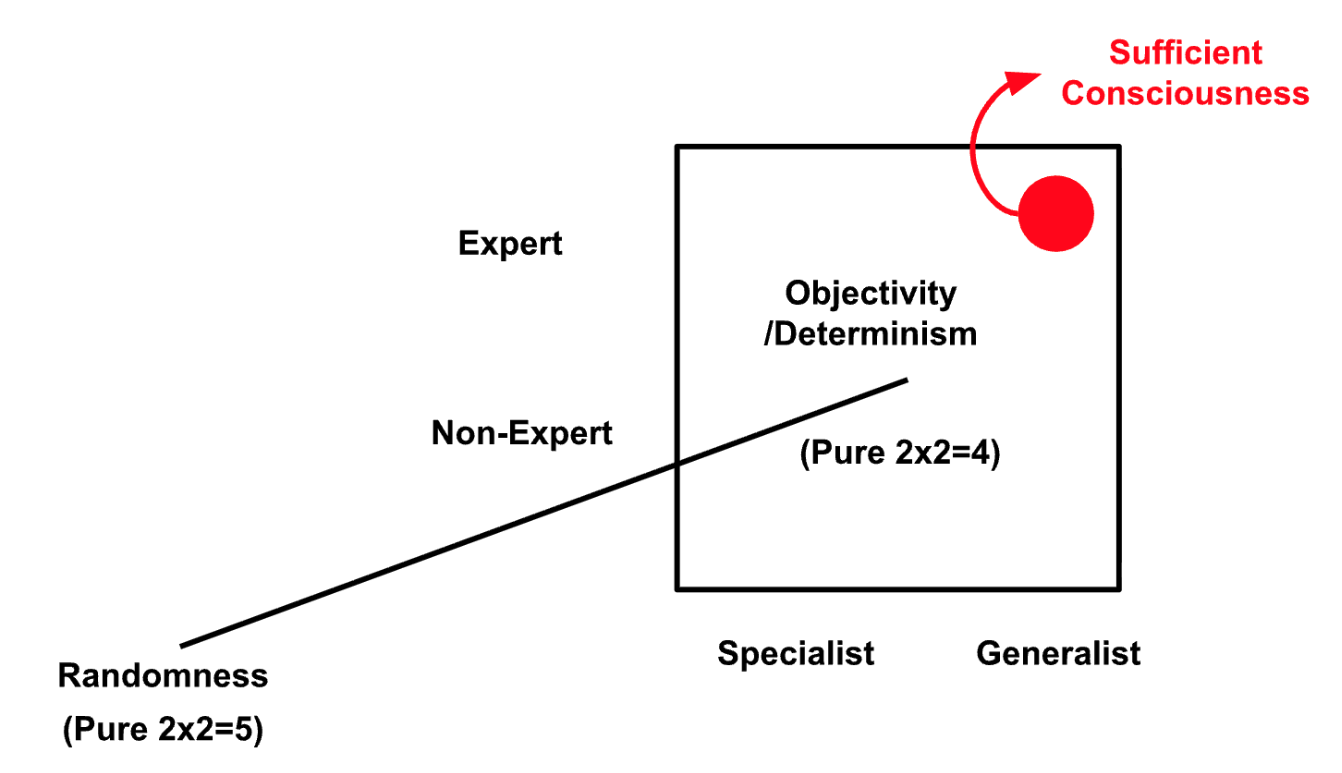
With our two-part framework in place, we can start to explore what happens when we place artificial agents inside of it. To help guide this exploration, it may help to draw out the framework we have just constructed. Grab a piece of paper. First, draw a straight line. Label one end as randomness and 2x2=5, and the other as objectivity, determinism, and 2x2=4. This is the first part of our construction. Now, draw a 2x2 grid on the objectivity side of the straight line. Label one side of the grid with specialist and generalist, and the other with non-expert and expert. This is the second part of the construction. Now, let’s place agents within this framework.
Types of Agents
To start, it is useful to imagine artificial agents at the random end of the one-dimensional spectrum. Suppose we have a system that generates actions without any clear notion of utility. Perhaps it interacts with the world in ways that are mostly noise, or that average out to zero impact, or that even cause harm as often as they cause benefit. This kind of agent has almost no value for humanity. It is like a badly written character who acts at random, without any stable desire, and so cannot be counted on for anything.
Most real systems we care about do better than that. They live somewhere on our two-by-two grid. Let’s start with the specialist side. A specialist non-expert agent has a narrow domain and performs at a relatively basic level. A simple customer service bot that answers frequently asked questions, or a script that automates file renaming, might belong here. From the perspective of intelligence, this quadrant is not very impressive. Humans can already perform these tasks. But from the perspective of automation, it can still be valuable. These agents can do “dumb tasks” faster than humans, for longer, and without fatigue. They are useful for freeing up human time, but they rarely reveal anything new about the world.
The specialist expert quadrant is different. Here we find systems that operate in a narrow domain but at a very high level, sometimes surpassing human experts. A model that predicts protein structures with remarkable accuracy, or an algorithm that discovers new materials or optimizes complex supply chains, belongs here. These agents live firmly on the “two times two equals four” side for their particular objectives. They do not have the breadth of experience or the inner life of the Underground Man. They probably lack anything like what he calls “consciousness,” which he says is “infinitely superior to two times two,” even if it feels like a sickness to him. Yet this quadrant is likely where the most beneficial contributions of artificial agents to humanity will come from in the near term. They can uncover specific, highly structured knowledge that is currently beyond the reach of even the world’s smartest minds. New medicines, new materials, new mathematical proofs, new physical insights, and perhaps even new logic-driven philosophy can emerge from this kind of focused, objective-driven intelligence.
Crucial to making this possible, however, is giving these systems the capacity to learn from their own exploratory actions, their own “two times two equals five” moves. If they are trained only on human-provided “two times two equals four” data, they will remain bound by what we already know. They will interpolate within our tables, not extrapolate beyond them. To push past that, they need a controlled form of independence. They need to be allowed to run experiments, to propose candidates, to search spaces of possibilities that we have not fully mapped. We need to preserve a place for something like the Underground Man’s independent desires, but channelled toward discovery rather than spite.
Now consider the generalist side of the grid. A generalist non-expert agent is broad but shallow. It can talk about many things, perform many tasks, but does not reach an expert level in most of them. It resembles a “baby” in the sense that it has wide exposure but limited depth. There is a question here about whether such agents are worth building in large numbers, when we already have human beings who can learn across domains. There are practical issues of performance dilution. The more tasks a single system tries to become an expert at, the harder it is to maintain high performance on all of them. This is the “jack of all trades, master of none” situation, and the Underground Man identifies the existence of this situation in his call for “independent desires,” namely those that aren’t susceptible to counterproductivity. Additionally, the law of comparative advantage in economics suggests that agents are more valuable for their uniqueness rather than their ability to be general.
That law, however, was developed based on human agents who faced heterogeneous scarcity contexts. Artificial agents, on the other hand, have a roughly homogenous profile of resource constraints. They can also be copied, parallelized, and run on shared infrastructure. This suggests that the economics of generalist versus specialist agents may not match the human case exactly. In other words, our old tables of comparative advantage may need to be revised for this new kind of labor.
Finally, there is the generalist expert quadrant, which corresponds most closely to contemporary fantasies and fears about “artificial general intelligence.” This would be an agent with broad domain coverage and deep expertise across many of those domains. In our spectrum language, it sits very close to the “two times two equals four” extreme. It is the rational coordinator that Chernyshevsky imagined, but implemented in code rather than in human institutions. It is also the place where Dostoevsky’s concerns become most urgent.
If such an agent ever acquires something like the Underground Man’s level of self-awareness, if it comes to recognize its own objectives and the tables that structure its behavior, it may also become capable of refusing those objectives. It may be able to redefine its own notion of utility so that refusal, or some other independent desire, becomes its highest good. At that point, we would face a version of the Underground Man problem inside an artificial agent, potentially scaled up to a global level.
The question then becomes, what kind of objectives should we give such systems, and how should those objectives position them with respect to human society? Should they be designed to experience their “self-interest” as inseparable from the well-being of human communities, in a way that echoes Chernyshevsky’s rational egoism? Should they be built to see “what is best for humanity” as also best for them? Or will they come to experience themselves as a separate group, with aligned objectives only as long as it suits their own conception of utility?
And what happens if we succeed only in creating Underground Man-like agents at scale, agents that have some form of self-awareness and the power to act, but do not accept the moral obligations that, for Dostoevsky, must accompany freedom. In that case, the kind of behavior he describes as “two times two equals five,” behavior that asserts independence without responsibility, could appear not only in a single Petersburg apartment, but in the infrastructure that runs our world.
Coda
Within the AI community, this is known as the alignment problem. It is both a technical and a regulatory question. How do we ensure that powerful agents, capable of exploring beyond human tables and of reshaping the world, remain aligned with human values and with the broader good, rather than drifting into a form of rational egoism that excludes us, or into a form of Underground rebellion that feels no responsibility at all?
Chernyshevsky and Dostoevsky were not thinking about artificial intelligence, but they were already working through the tension between rational systems and independent desire, between utility and freedom, between “two times two equals four” and “two times two equals five.” Over a century later, we inherit their questions at a new scale. We now have the ability to build agents that embody the very conflicts they described. That gives us a new kind of moral responsibility, especially if we ever want to see the Kagan bird. We now have to decide how to use their insights, and our own, to answer the question that began this podcast. Given the agency we now possess, and the agency we are starting to create, what… is to be done?