Mihir Rao

Feed

Select writing from across sources which form a cohesive arc of thinking.

Persistent Value

Disclaimer. These views are entirely my own and do not reflect those of my current or past employers.

Knowns (as of July 2026)

A. The lab duopoly has hit recursive self-improvement. This will yield an exponential increase in the pace of general models climbing domain-specific evals via RLVR. The labs can curate these evals both internally and via external vendors like Mercor or even legacy/incumbent organizations within verticals (e.g. pharma for drug development evals). In summary, the labs own general purpose models which are sufficiently capable at specific domains.

B. Although varying in their technical and operational approaches, third-party AI service providers like Palantir, Databricks, and Applied Compute bet on the existence of valuable customer-specific "tribal knowledge" (information, processes) and thus unique evals and corresponding hill-climbs which justify "forward-deploying" into customers in order to compound the latent value sitting within the customer (for the customer). We can call this phenomenon customization ops. This is instead of being entirely product-driven, which suffers from a lack of specificity which prohibits effective compounding around unique hill-climbs of value to the individual customer.

C. There are focused, vertical, and even subdomain-specific, companies that are internally AI-native, and aim to compound on their own expertise. Examples include Formation Bio, Cambium AI, Anduril, and SpaceX. They have verticalized, owning the full stack, and operate such that they can defend against the labs infiltrating their domain. They achieve this via moats in, amongst others, the following categories: infrastructure, operations, data, relationships, legal. These are real, high-activation-energy moats against digital AI from the labs, not a weak "moat" in the way that Palantir used to have an operational moat with the FDE model (which is now commoditized).

Possible Futures

Let's throw a few, mutually-inclusive, possibilities on the table...
keep reading

Counter-Computing Biology

The lac operon performs analog integration: a graded, concentration-dependent response to two chemical inputs whose combined logic governs whether a bacterial cell expends energy on transcription. Signal transduction cascades sharpen graded inputs into near-threshold responses through Hill function kinetics. The neuron is the most familiar example: dendrites sum continuous analog inputs, and only when the weighted sum crosses a membrane potential threshold does the cell fire a discrete spike. The immune system runs an analog optimization, continuously tuning antibody affinity through iterative selection by gradient descent.

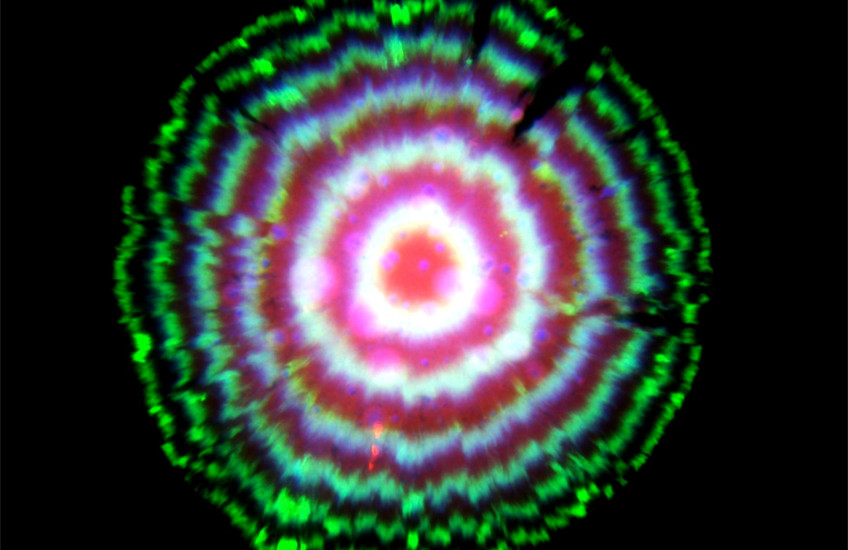
What looks digital emerges from this analog foundation. The bistable toggle switch and the three-gene repressilator, constructed in E. coli and published back-to-back in Nature in 2000, demonstrated that Boolean logic and clocked circuits are emergent properties of the same analog biochemical parts. Biomolecular condensates add a further layer, sorting molecular species into compositionally distinct compartments through analog phase separation thresholding. The system also has memory of two kinds. The genome is digital memory: a discrete sequence encoding the parameters that govern the analog computation. Biology also maintains analog memory: synaptic weights, continuously graded by long-term potentiation and depression, store the history of neural computation without discrete states; epigenetic marks do the same at the genomic layer, recording the analog history of prior gene expression across cell divisions without altering the sequence. Although running on wet chemistry not dry silicon, biology is computing.

Colonies of bacteria containing the repressilator circuit develop different patterns of “growth rings” over time. Credit: Silver Lab. Colonies of bacteria containing the repressilator circuit develop different patterns of “growth rings” over time. Credit: Silver Lab.

Computational biology is a counter-computational effort: it reads the informational output of biology’s analog computations, performs its own computations using that information, and injects information back into biology’s programs as targeted perturbations of the analog or digital kind (e.g. therapeutics and supplements perturb analog dynamics; gene edits rewrite the underlying digital sequence). Variant-calling pipelines translate continuous mutational landscapes into actionable discrete calls; structure-guided drug design closes the loop by producing molecules targeting specific allosteric or catalytic nodes, with imatinib against BCR-ABL as the canonical example. Pharmacogenomics showed the same logic individually: sequence variation in drug-metabolizing enzymes determines whether a standard dose heals or harms. Biodefense must counter-compute at a blitz: the SARS-CoV-2 spike sequence appeared in January 2020 and an mRNA vaccine entered a human arm within eleven months...

keep reading

Chernyshevsky, Dostoevsky, and Artificial Agency

This is the script for a podcast I created as part of a course on Russophone literature. It explores the themes of emergence and agency through the lens of Nikolay Chernyshevsky’s What is to Be Done? and Fyodor Dostoevsky’s Notes from the Underground. The final sections of the podcast apply Chernyshevsky’s and Dostoevsky’s ideas through a joint framework to the artificial agents of today and tomorrow, and highlight the possibility of emergent irrational behavior.


Introduction

What you are listening to… are the fluctuations of the air between my mouth and my microphone, transmitted to you through electron flow, mechanical transduction, and more sound waves. But it is also something you recognize as a podcast, an object that contains meaning. My goal is to showcase this duality of the world we find ourselves in. I also want to understand its implications, both for our individual human selves and for the technologies we are creating. This podcast is possible due to what we have deemed as determinism, yet we experience an emergent interpretation of it that does not require us to process the dynamics of air molecules. It is from this emergence that all that we are and all that we know has come to be. We have been granted seemingly infinite possibilities, so what is to be done?

Preliminaries

Chernyshevsky’s What Is to Be Done? advances the doctrine of “rational egoism,” the idea that if individuals step back and use reason, they will recognize that their true self-interest ultimately coincides with the good of humanity as a whole, that “good” is synonymous with utility, and that a rationally organized society, his utopian Crystal Palace, can be designed around this alignment. Notes from the Underground is Dostoevsky’s polemical response to this vision. Instead of writing a straightforward review, he creates the Underground Man, a narrator who exaggerates and parodies Chernyshevsky’s premises in order to expose their limits...

keep reading

If biology needs AI

If biology needs AI, biology needs data.

Reductionism has prevailed in the life sciences because progress would have been intractable without it. Identifying reliable subsystems, discerning their interactions, and rationalizing interpretations of causality has brought us far. Reductionism also dictates which features of the world we choose to measure—what data we collect. This approach to thinking is not unique to the life sciences, with the financial services and technology industries having broadly applied systems thinking over the same period of time. Across these industries, the limitations of systems thinking have been clear. Even in its quantitative-first era, biology speaks in the language of probabilities and randomness—Latin for “my model of the world is informationally-incomplete.”

This is cause for concern and motivation because it indicates, at minimum, a partial incompatibility between our objectives and the information frameworks in which we hope to achieve them. Some diseases offer a tractable chain of causality along which we can engineer our objective of eradicating them. Other grander objectives encompass vastly more complex mechanics that have been pressure testing our models of life. This is not an argument against reductionist thinking, but rather the statement that we have yet to fully explore the phase space of even our current reductionist framework. As a result, it is simultaneously true that we have both made tremendous progress in understanding biology and that we have left much room for improvement. We have made meaningful progress on many surrogate objectives, created biological and clinical frameworks that enable these heuristics, and have designed our industry around this way of work. Better, more elegant solutions, however, are still out there.

The purpose of AI in the life sciences is not to discern knowledge beyond the scope of today’s reductionism, but rather to enable efficient coverage of the reductionist phase space that remains unexplored. If AI is the necessary path forward, then consider the scaling laws. We get much of the algorithms and compute for free from broader progress in research and technology, but biological data remains a bottleneck. Who are the life science industry’s data generators? While academic labs and hospitals offer unique data, their ability to support the quality and volume demands of early AI scaling is currently bottlenecked by limited infrastructure and tight regulation. In-house experimental capabilities can generate a lot of first-rate data, but biopharma has a bias to spending on external data vendors (CRO/CDMO) over high-capex internal builds. Exceptions include the new breed of techbios that are AI and computation-native and thus choose to invest in their own high-throughput data factories...

keep reading

biology needs jacks of all trades, masters of all

There are walls in science that need to be broken down for the sake of biology.

Life is an abstraction of chemical and physical processes. Each discipline has traditionally focused on reality at different scales, yet both, along with traditional descriptive biology, seem relevant to the quantitative arena biology is today. People like Stephen Wolfram have shown that computation, much like mathematics, is a fundamental representation of logic and physical laws, so it is no surprise that ideas from computer science seem to emerge in living systems. Take thymic education, for example.

There is a sense of both intellectual and practical comfort in restricting oneself to a type of scientific engagement. A theorist/computational scientist does not need to worry about maintaining equipment and performing intricate experimental protocols. Similarly, traditional experimentalists need not concern themselves with the rich opportunities for mathematics, physics, and computer science to deliver biological insights.

We must urgently force ourselves to lose this sense of comfort.

Constructing an engineerable blueprint of life is a grand endeavor consisting of solutions to health, general intelligence, energy, and the climate. To get there, we must think in systems and from first principles. Innovation by superscientists who integrate the natural sciences with mathematics, computer science, and engineering principles, as well as seamlessly move between the blackboard, bench, and computer, is necessary.