Counter-Computing Biology
The lac operon performs analog integration: a graded, concentration-dependent response to two chemical inputs whose combined logic governs whether a bacterial cell expends energy on transcription. Signal transduction cascades sharpen graded inputs into near-threshold responses through Hill function kinetics. The neuron is the most familiar example: dendrites sum continuous analog inputs, and only when the weighted sum crosses a membrane potential threshold does the cell fire a discrete spike. The immune system runs an analog optimization, continuously tuning antibody affinity through iterative selection by gradient descent.
What looks digital emerges from this analog foundation. The bistable toggle switch and the three-gene repressilator, constructed in E. coli and published back-to-back in Nature in 2000, demonstrated that Boolean logic and clocked circuits are emergent properties of the same analog biochemical parts. Biomolecular condensates add a further layer, sorting molecular species into compositionally distinct compartments through analog phase separation thresholding. The system also has memory of two kinds. The genome is digital memory: a discrete sequence encoding the parameters that govern the analog computation. Biology also maintains analog memory: synaptic weights, continuously graded by long-term potentiation and depression, store the history of neural computation without discrete states; epigenetic marks do the same at the genomic layer, recording the analog history of prior gene expression across cell divisions without altering the sequence. Although running on wet chemistry not dry silicon, biology is computing.
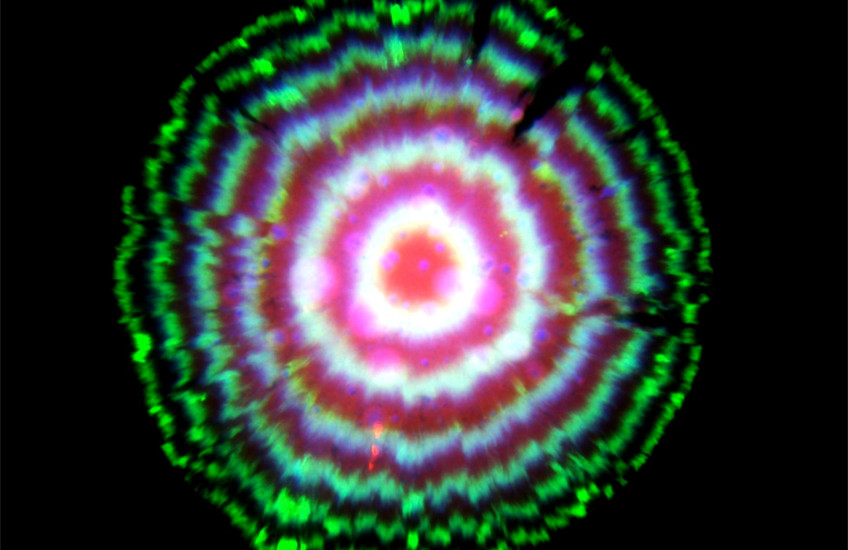 Colonies of bacteria containing the repressilator circuit develop different patterns of “growth rings” over time. Credit: Silver Lab.
Computational biology is a counter-computational effort: it reads the informational output of biology’s analog computations, performs its own computations using that information, and injects information back into biology’s programs as targeted perturbations of the analog or digital kind (e.g. therapeutics and supplements perturb analog dynamics; gene edits rewrite the underlying digital sequence). Variant-calling pipelines translate continuous mutational landscapes into actionable discrete calls; structure-guided drug design closes the loop by producing molecules targeting specific allosteric or catalytic nodes, with imatinib against BCR-ABL as the canonical example. Pharmacogenomics showed the same logic individually: sequence variation in drug-metabolizing enzymes determines whether a standard dose heals or harms. Biodefense must counter-compute at a blitz: the SARS-CoV-2 spike sequence appeared in January 2020 and an mRNA vaccine entered a human arm within eleven months.
The outstanding problem is that this analog computation is irreducibly individual. The full state of a biological organism spans genome, epigenome, transcriptome, proteome, metabolome, microbiome, developmental history, and ongoing environmental inputs; no two organisms run the same program. Disease is an analog computation drifting from its healthy attractor: not a binary fault but a parameter shift that destabilizes a feedback loop, moves a signaling equilibrium, or traps the system in a pathological basin. Population-level statistics average over the very variation that determines outcome. Closing that gap requires reading and countering the specific program running in a specific organism.
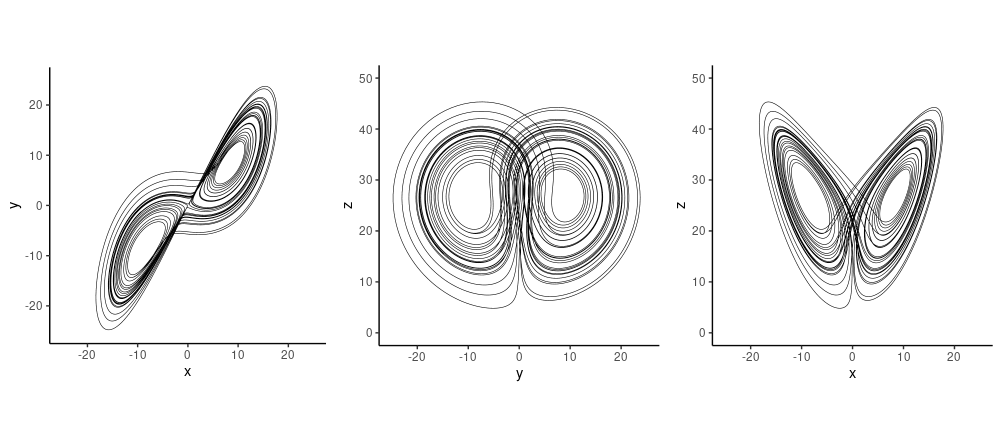 Attractors in dynamical systems.
In 2025, Paul Conyngham, an Australian data engineer with no biology training, used a large language model, open genomic sequencing pipelines, and computational vaccine design to generate a personalized mRNA therapy for his dog Rosie’s terminal cancer; the approach drove measurable tumor reduction and bought her more time. Sid Sijbrandij, co-founder of GitLab, assembled AI systems and geneticists to model his osteosarcoma computationally after exhausting standard of care, and is currently showing no evidence of disease. The same year, the Children’s Hospital of Philadelphia delivered the first patient-specific CRISPR base-editing therapy for a fatal metabolic disorder within months of diagnosis. At the commercial tier, Function Health and Fountain Life offer AI-integrated diagnostic dashboards giving individuals a molecular readout of their own biology at a depth previously confined to research settings. At the institutional tier, NHS genomic medicine and precision medicine programs are embedding genome-scale data into routine clinical care at population scale. The analog program of biology is becoming legible and increasingly rewritable across all three.
This is both an opportunity and a design challenge for today. Population-level strategies are tractable but can lack specificity; effectively personalizing beyond them requires multimodal longitudinal data tracking how biology is changing over time. N=1 counter-computational efforts are now arising in consumer, commercial, and institutional settings simultaneously, each generating exactly that data, and if made accessible it would improve every subsequent instance of counter-computing biology. Conyngham’s canine mRNA experiment and Sijbrandij’s computational oncology operation each produced data that should feed back into the variant-to-therapy loop; most of it will not, for want of infrastructure. Interoperable data standards letting individual-scale interventions inform population-scale learning that flows back to individual benefit, and regulatory frameworks distinguishing dangerous experimentation from well-instrumented N=1 counter-computation, are the immediate engineering problems. A robust digital integration layer is best positioned at the nexus of individuals, computational tools, and the clinical infrastructure needed to validate the information that is generated. Every unrecorded N=1 counter-computation is rich data the field never sees. Building the infrastructure to capture it, no matter where it happens, is the next experiment worth running.
Acknowledgements
Thank you to Puneeth Iyengar, MD, PhD for helpful feedback. All mistakes are mine.